
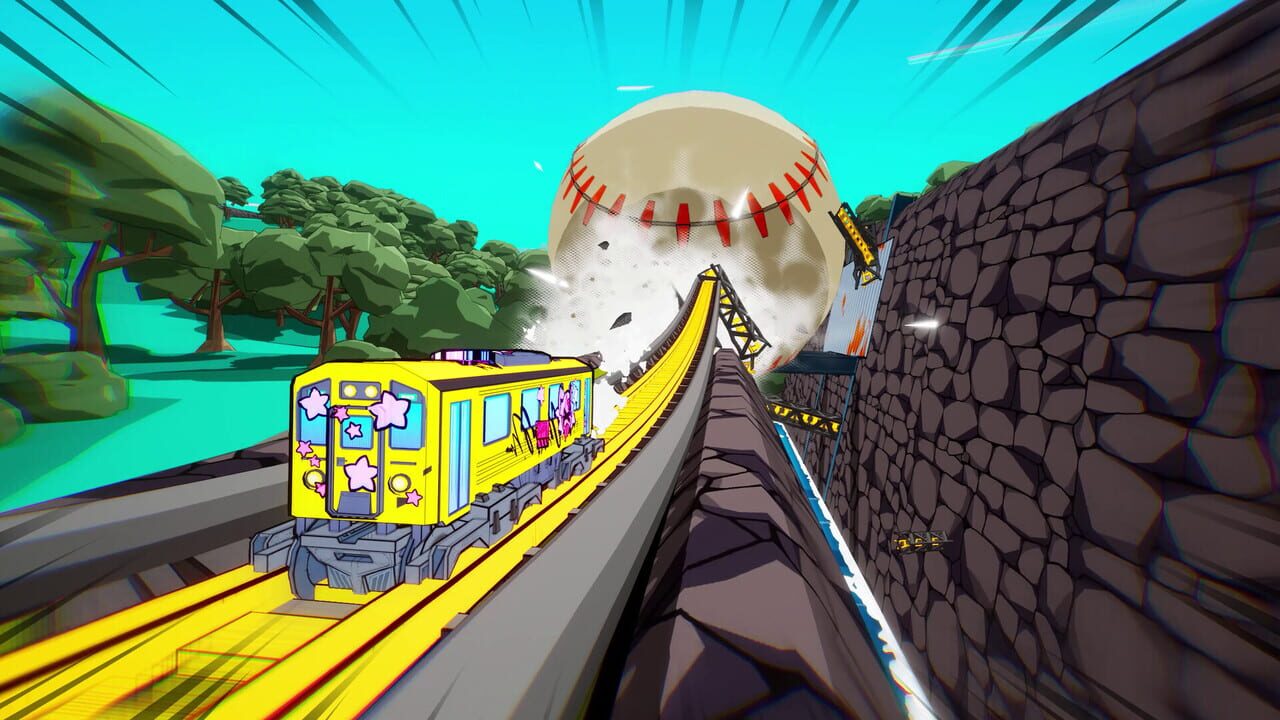
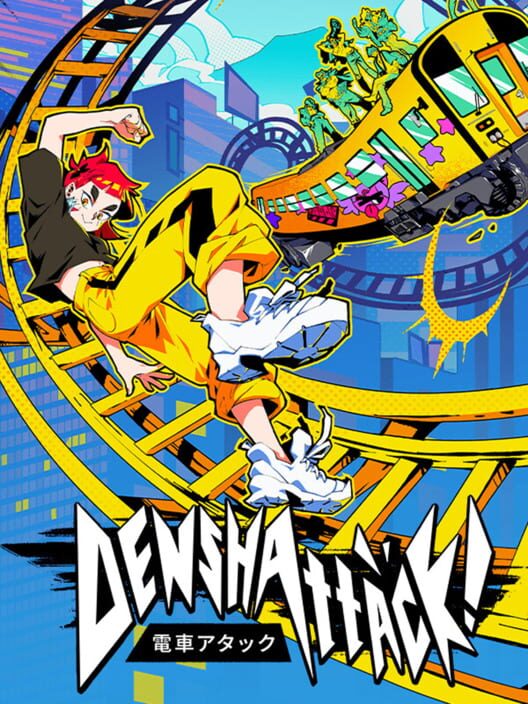
Denshattack! is the kind of game that sounds like somebody lost a bet and then decided to win it anyway. A trick-score action game about a ramen-delivering train tearing through a climate-ravaged future Japan should probably be too much. Maybe it is too much. That seems to be part of the point.
What makes it worth paying attention to this week is not just the premise. It is the shape of the reviews. OpenCritic currently lists Denshattack! with an 88 average from 57 critic reviews, 95 percent recommended, and a "Mighty" rating. That is a big number for a new, strange, arcade-minded game from Undercoders and Fireshine Games, especially one that is arriving first into a crowded mid-summer calendar.
The clean version is simple: most critics think Denshattack! is a blast. The messier version is more useful. Reviewers are praising its momentum, style, and trick system, but the few lower scores are not confused about what the game is trying to do. They are pushing back on bloat, uneven theme work, and a campaign that sometimes piles story and structure around a very sharp arcade hook.
That is the interesting part. Denshattack! is not being received as a polite indie curiosity. It is being reviewed like a game with a real identity, one strong enough to make some critics forgive its excess and strong enough to make others wish it trusted its best idea more.
Denshattack! review scores: the quick read
OpenCritic lists Denshattack! as an 88 overall, with 57 critic reviews and 95 percent of critics recommending it. Its release date is listed as June 15, 2026 for Nintendo Switch 2 and PC, with PlayStation 5 and Xbox Series X/S versions listed for July 15, 2026. OpenCritic names Undercoders and Fireshine Games as the creators, with Undercoders identified as developer and Fireshine Games as publisher.
The spread is where the story starts. Eurogamer gives it 5 out of 5 and calls it "irreverent, unpredictable, funny, and unputdownable," describing it as "anti-capitalist, pop-punk optimism distilled." IGN gives it 9 out of 10 and says that "hitting the track and chaining tricks together" is a joy, helped by a campaign that keeps finding new ideas. TheGamer also lands at the top end, calling it "one of the fiercest, fastest, and most lovable games" the reviewer had played in quite some time.
Then there is PC Gamer at 63 out of 100. That review calls Denshattack! "an inconsistent spectacle" that does not make good use of its chosen themes. Nintendo Life sits closer to the middle-positive range at 8 out of 10, calling it a satisfying Dreamcast-style homage, but also saying the core hook is surrounded by needless fluff.
So, no, this is not a clean consensus where everybody says the same sentence in different house styles. The high scores are very high. The doubts are specific. The game seems to live or die on how much patience a reviewer has for its everything-at-once energy.
Why critics are so taken with Denshattack!
IGN's Will Borger describes Denshattack! as a game that feels like Tony Hawk's Pro Skater and Jet Set Radio somehow got fused together, except the board is a train and the setting is a stylized, damaged future Japan. That comparison matters because it gives the praise a frame. Critics are not just saying "this is quirky." They are placing it near games where flow, style, repetition, and mastery all feed each other.
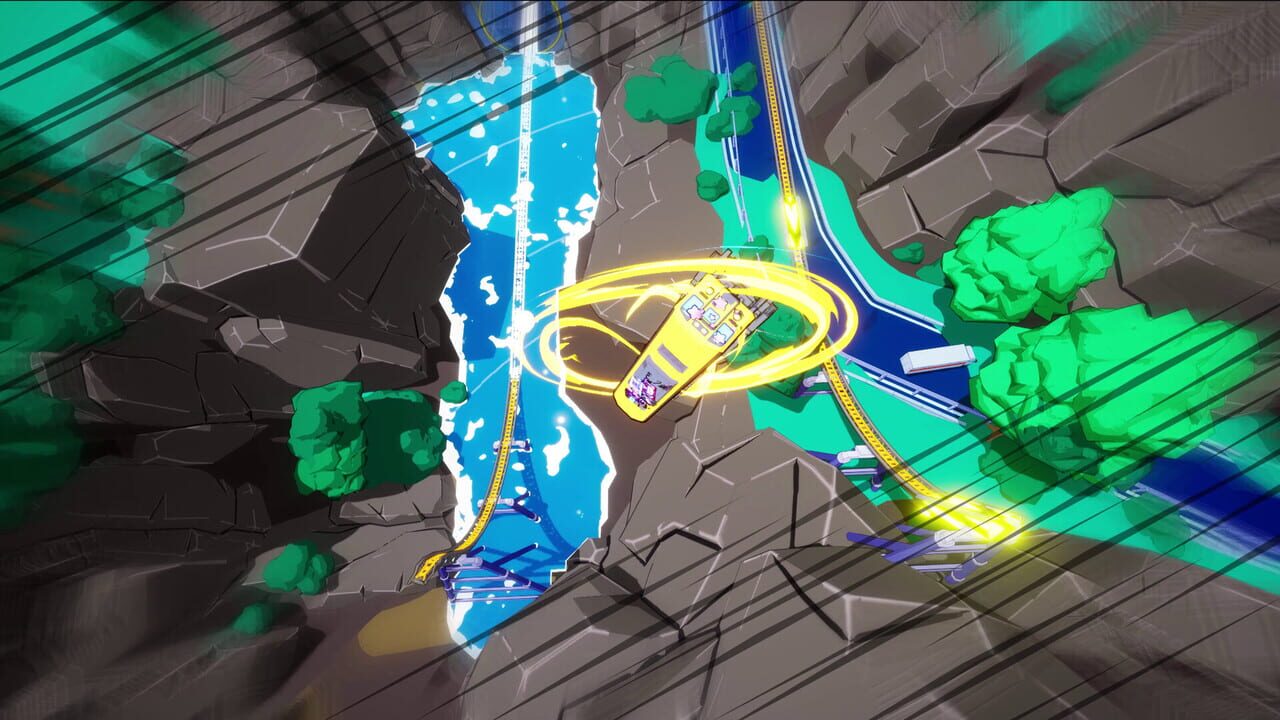
The trick system seems to be the centre of that praise. IGN notes that tricks are mapped to the right analog stick, with more elaborate moves asking for more elaborate motions. The review says that the deeper tricks can start to feel like fighting game inputs, which is exactly the sort of detail that separates a cute gimmick from a system people will actually learn. A game about a flipping train could have stopped at the joke. Denshattack! apparently keeps going until the joke becomes a skill.
That is also where the Dreamcast comparisons come from. Nintendo Life calls it an effective homage to Sega's Dreamcast era without feeling too derivative. That is a narrow needle to thread. Too much homage and you get a costume. Too little and the comparison becomes a lazy shortcut. The praise here suggests Denshattack! borrows a feeling rather than a checklist: loud colour, arcade clarity, quick restarts, score chasing, and a slightly ridiculous confidence that the player will either keep up or enjoy trying.
Eurogamer's praise is more emotional. The outlet's OpenCritic snippet leans into the game's politics and spirit, calling it pop-punk optimism. That is a good phrase because it gets at something score numbers often miss. Denshattack! appears to be cheerful without being empty. It is anti-corporate, bright, silly, and sincere at the same time. That combination can curdle fast if the writing is thin or the pacing is off, but the highest-scoring reviews seem to think it works because the game is not embarrassed by itself.
The best review consensus, then, is not just "the train game is fun." It is that Denshattack! has enough mechanical bite to support its style. The spectacle is not decoration. It is part of how the game communicates momentum.
Where the Denshattack! reviews split
The criticism is just as useful as the praise because it points to the risk baked into the design. A game this loud has to keep earning the noise. If the levels, story, and themes all fight for attention, the strongest system can get buried under its own packaging.
PC Gamer's 63 is the clearest outlier among the major English-language scores surfaced by OpenCritic. The snippet is blunt: Denshattack! is "an inconsistent spectacle" and does not make good use of its themes. That is not a complaint about polish alone. It suggests a gap between what the game says it is about and what the play actually delivers.
Nintendo Life's 8 out of 10 lands in a softer version of the same concern. It praises the arcade hook and says using a train to pull off tricks works better than it sounds, but it also argues that the surrounding material bloats the experience. The review says Denshattack! may have shone brighter if the developers had leaned further into the arcade-style inspiration. That is a familiar problem for ambitious indies: the team builds a wonderful core, then keeps adding reasons, framing, systems, and scenes around it because the core feels too small to carry the whole thing.
I am not sure that is always a mistake. Some games are better because they have extra corners. The friction is part of the memory. But review aggregation is useful here because it shows the tradeoff before you buy. If you want a pure score-chase machine, the lower critiques matter. If you like games that arrive with their whole messy personality intact, the high scores probably tell you more.
There is also a platform wrinkle. OpenCritic's listing separates the June 15 release for Switch 2 and PC from the July 15 release for PS5 and Xbox Series X/S. That matters because the current review wave is landing right as the console audience widens. A score average this high will pull in players who did not follow the PC or Switch 2 conversation in June. For them, the question is less "what is this?" and more "is the hype real?"
The answer, based on the reviews, is mostly yes. With a small but important asterisk: the hype is real if the premise already makes you smile.

The quiet reason Denshattack! matters
Denshattack! feels like one of those games that could get flattened by the release calendar if the numbers were merely fine. It has an odd name, a weirder pitch, and no obvious licensed safety net. In another week, maybe it becomes a thing people recommend in replies for six months. This week, because the critic scores are loud enough, it has a better chance of being noticed while the conversation is still warm.
That matters for players too. Not in a grand industry way. More in the small, practical sense that some games need to be caught at the right moment. If you save Denshattack! to a wishlist because a critic's line stuck with you, or because a friend says it feels like a lost arcade game from a stranger timeline, that first reason is worth keeping. Later, when the store page is just another tile and the review score has lost its context, it helps to remember what made you curious in the first place.
That is close to how we think about games at Perthro. A score can point you somewhere, but it rarely explains why you cared. The useful bit is the note beside it: Eurogamer loved the spirit, IGN loved the trick chaining, PC Gamer bounced harder off the thematic execution, Nintendo Life liked the foundation but wanted less clutter. That is enough to make a better decision than the average alone.
For Denshattack!, the average is doing its job. An 88 from 57 OpenCritic reviews tells you this is not just a novelty with a good trailer. The spread tells you what kind of player should lean in. If you miss arcade games with nerve, if you like trick systems that ask to be learned, if you have room for a story that might be too earnest and too loud, this is one to watch closely.
If you need clean minimalism, maybe wait. The train is apparently very good. It is also carrying a lot.