
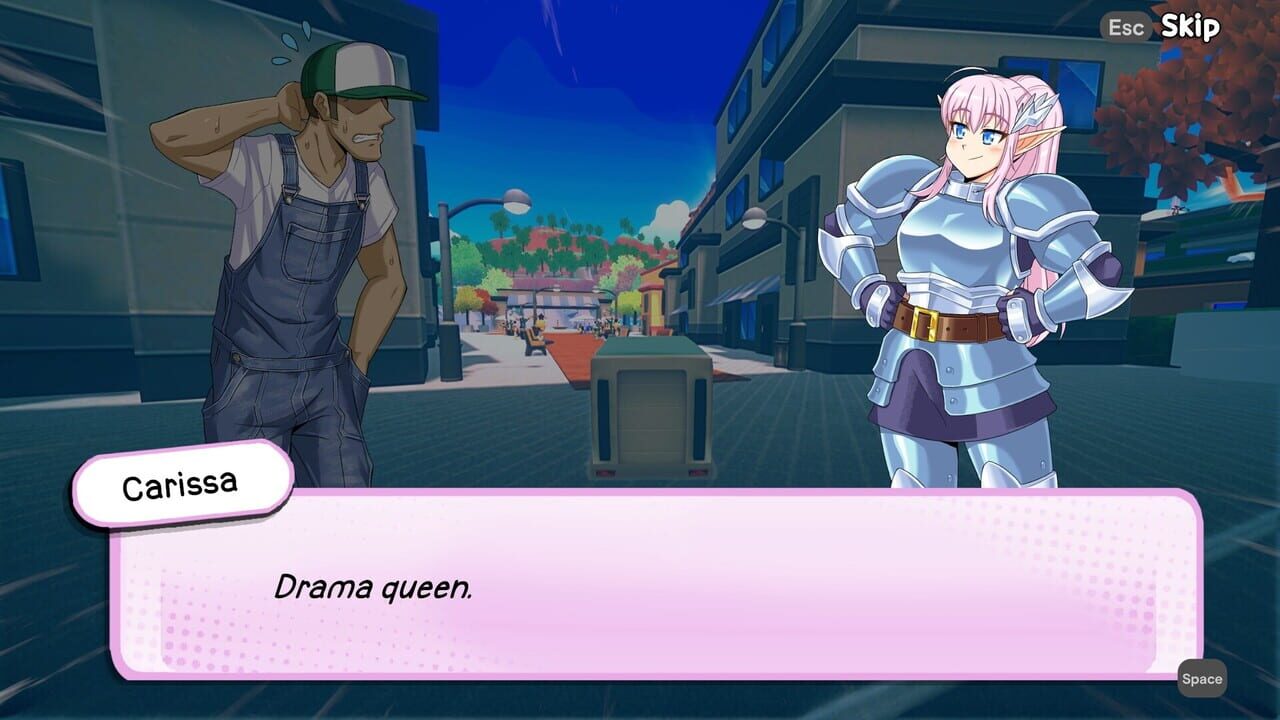
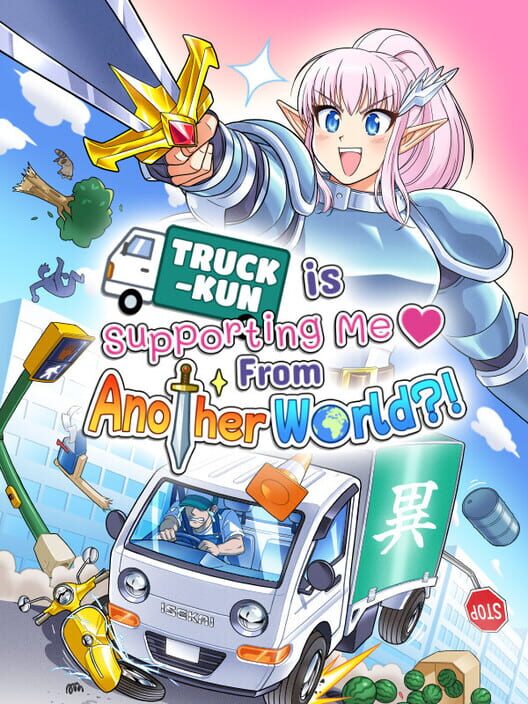
Truck-kun is Supporting Me from Another World?! is the kind of game that makes you want to know the punchline before you know the score. The title is almost the whole pitch: Strange Scaffold and Frosty Pop made an isekai parody where the mythical truck does not vanish after sending someone to another world. It sticks around, drives through a small city, hits pedestrians, feeds monsters into a fantasy battle, and tries to help an overworked office climber get back home before Monday.
That is a good bit. Maybe even a great one. The critic response says the harder question is whether it is a good game for long enough.
OpenCritic lists Truck-kun is Supporting Me from Another World?! at a 71 Top Critic Average with 53% of critics recommending it, based on 17 critic reviews. The visible score spread is wide: The Outerhaven and Gamers Heroes are up near 9/10 and 80/100, Shacknews gives it 8/10, CGMagazine lands at 7/10, DualShockers at 6/10, Gamer Social Club at 5.5/10, and MonsterVine at 2/5. That is not a tiny wobble around the same conclusion. That is a real split.
The reason is pretty clear after reading the reviews. Critics mostly agree on what Truck-kun is. They disagree on how much patience they have for it once the joke has finished introducing itself.
Truck-kun review scores: the quick read
Truck-kun is Supporting Me from Another World?! released on July 29, 2026 for PC and Xbox Series X/S. OpenCritic lists Strange Scaffold, Frosty Pop, and Strange Scaffold as creators. The game is short, usually described by reviewers as a three to four hour arcade run. It riffs on the anime and manga trope where a character is sent to a fantasy world after being hit by a truck, then twists the formula by making the driver a co-star.
The most enthusiastic reviews treat that tight scope as part of the charm. Shacknews' Lucas White gives it 8/10 and calls it "one of the most memorable games of the year so far," praising the way Strange Scaffold commits to the bit without pretending it is bigger than it is. The Outerhaven's Scott Adams says he "had a blast" with it, while Gamers Heroes calls its arcade loop "zany" and "satisfying." Those reviews are not asking Truck-kun to become a sprawling comedy RPG. They are taking it as a compact arcade oddity.
The lower reviews are not confused about the premise. They just think the game exhausts it. DualShockers' Daniel Trock gives it 6/10 and says he was "palpably bored" after about two hours, with the final stretch turning into "an agonizing slog." MonsterVine's James Carr is harsher at 2/5, arguing that the shallow gameplay does not evolve and that the repeated runs feel like grinding for grinding's sake. Gamer Social Club sits nearby at 5.5/10, saying the charm is there, but that the barebones structure and lack of variety cannot sustain even the modest runtime.
So the useful score range is roughly 40 to 90 depending on outlet format. More importantly, the useful disagreement is simple: if you find the driving chaos funny and enjoy squeezing score-attack objectives out of a tiny city, Truck-kun has a real chance to work. If you need escalation, new ideas, or sharper variation, the wheels seem to come off quickly.
The premise is doing a lot of work
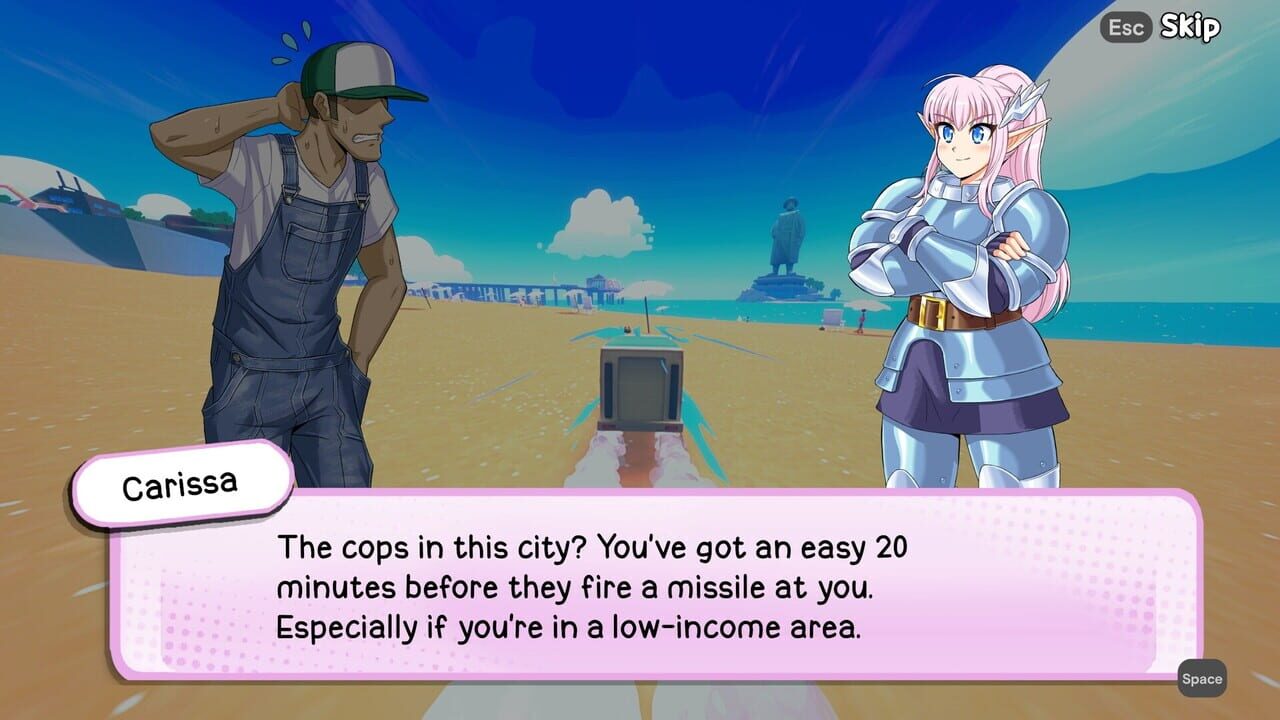
Truck-kun begins with Carissa Ward, a career-focused office worker who gets hit by a delivery truck just as her professional life is supposed to pay off. Instead of dying in the usual way, she wakes up in Talinfold as a fantasy heroine. The driver, guilty and confused, can still communicate with her. The plan becomes absurdly practical: keep running people over so they appear in Carissa's world as monsters, then let her defeat them, level up, and hopefully return home before work starts again.
That setup is the best thing about the game. Even the negative reviews tend to respect it. DualShockers says the initial hook is "very strong." Gamer Social Club liked the way the writing briefly touches on burnout culture and escapism without trying to become more serious than the joke can support. CGMagazine frames it as an unapologetically goofy city sandbox where the player teams up with Carissa to stop the Skeleton King and get back to the real world.
I like that the joke has two targets. It is not only poking at isekai cliches. It is also poking at work culture, the horror of Monday, and the way a fantasy afterlife still has to negotiate with someone's calendar. That is a small, mean, funny idea. It fits Strange Scaffold, a studio that tends to make games with strong premises and strange emotional angles.
The problem is that a premise is not a structure. A title can carry you into a review. It cannot carry four hours by itself.
Why the positive reviews click with it
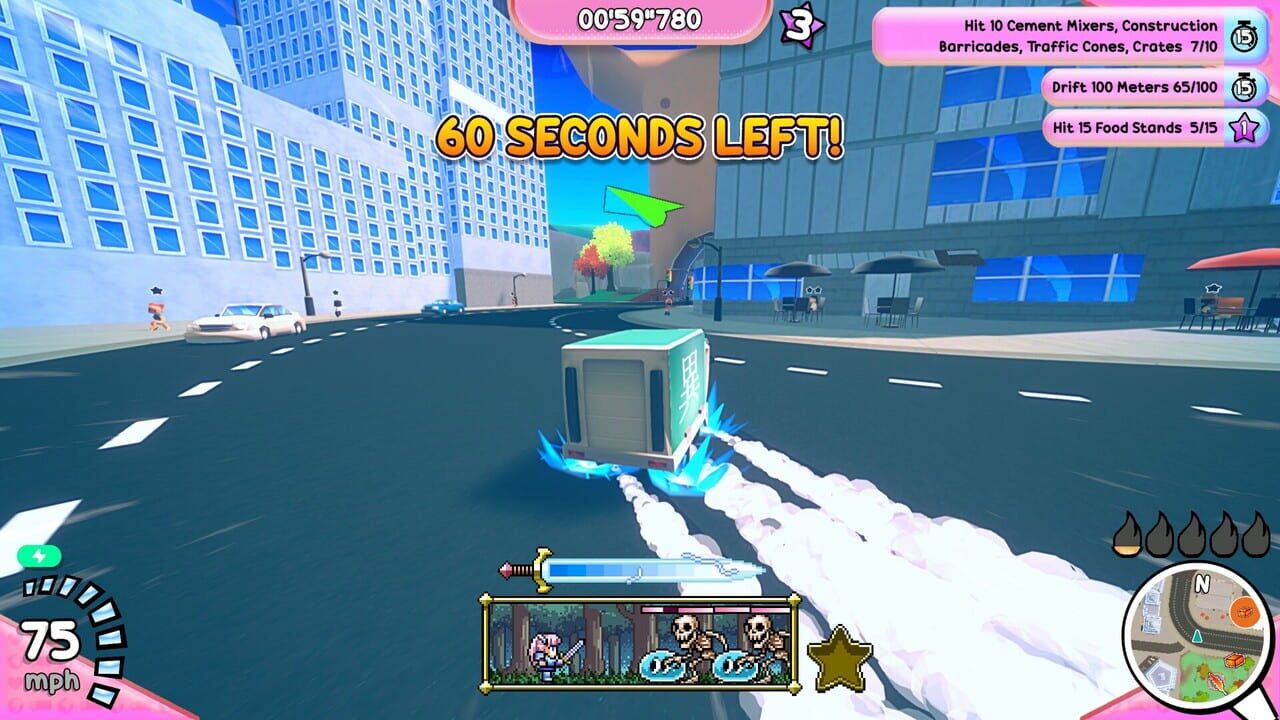
The pro-Truck-kun camp responds to momentum. Shacknews compares the setup to a "depraved version of Crazy Taxi," which is probably the cleanest mechanical shorthand. You drive through Wenvale, crash into pedestrians and objects, fight cops, complete quick objectives, grab deliveries, hit jumps, and feed Carissa's little pixel battle window at the bottom of the screen. Objects power her special attack. Pedestrians become enemies for her to fight. The whole thing is ridiculous, but the better reviews argue that the ridiculousness has rhythm.
Shacknews is especially useful here because the review acknowledges the small scale while still finding pleasure in it. The game is not terribly complicated, but blasting around at speed, knocking over cartoon people, smashing through objectives, and watching Carissa clear enemy queues gives it a physical comedy loop. The review also notes that story progression can slow down and feel grindy near the end, which makes the 8/10 more persuasive. It is not blind praise. It is a critic saying the fun outweighed the drag.
CGMagazine's 7/10 reads similarly, though more reserved. Zubi Khan describes the city as a sandbox for mayhem, with objectives ranging from destroying parked cars and fences to gaining airtime, blasting through billboards, and hitting special shielded targets with boost or side-slam abilities. That review seems to value Truck-kun as a simple arcade toy: clear verbs, readable chaos, one silly idea followed through.
There is a pattern in the praise. Nobody is saying Truck-kun is deep. They are saying it knows how to be brief, stupid, and tactile.
Where the game loses critics
The negative reviews focus on repetition. Not bad controls. Not broken performance. Repetition.
MonsterVine lays it out most plainly. The game is built around repeated timed runs through the same small city. Objectives are randomized, but the tasks are familiar: hit parked cars, drift for a certain distance, honk the horn, evade cops, collect stars, build meters. At first, that can feel frantic. Then the reviewer found routines, such as returning to a parking garage when the game asked for parked cars, and the city started to shrink in his head. A sandbox stops feeling like a playground when you know exactly which corner you need for the next chore.
DualShockers lands in almost the same place from a different angle. Trock says the game looked like it should be a wacky Crazy Taxi-style spin on isekai, but that the story does not really go anywhere after the strong opening. The review describes the last hour as a slog, which is a brutal thing to say about a game this short. If a three to four hour game feels padded, the padding is hard to forgive.
Gamer Social Club is the fairest middle ground. Daire Behan says the early moments have thrill because the player is juggling fast driving objectives with Carissa's battle window. Then the review argues that Truck-kun reveals most of what it can do within the first few runs. That is the hinge point. Some players enjoy mastery through repetition. Others read repetition as absence.
This is why the OpenCritic number is less useful than the spread. A 71 average can make Truck-kun look like a modestly okay game. The actual critic conversation is sharper. A few outlets found a memorable, compact arcade joke. A few found a thin game that ran out of road.
Why this one matters for Perthro readers
Truck-kun is Supporting Me from Another World?! is exactly the sort of game where a single score is almost useless. A 71 average does not tell you whether you will like it. The deciding factors are more personal: tolerance for repetition, love of isekai parody, appetite for arcade objectives, fondness for Strange Scaffold's tone, and whether a deliberately stupid premise sounds refreshing or exhausting tonight.
That is why I would not treat this as a simple buy-or-skip. I would treat it as a note.
If you use Perthro to track games you are playing, have played, plan to play, or shelved, this is a good candidate for a short personal tag in your own words: "short weird arcade joke," "try when I want Crazy Taxi nonsense," "probably too repetitive for me," or "Strange Scaffold curiosity." A review score can tell you the room is divided. Your own note can tell future-you why you cared in the first place.
The best case for Truck-kun is that it is memorable. Even some of the colder reviews prove that. Nobody sounds indifferent. They sound amused, disappointed, delighted, bored, or briefly charmed. That is not a bad fate for a game about a delivery truck committing magical vehicular manslaughter in the name of career recovery.
The safe read is this: Truck-kun is Supporting Me from Another World?! is a short, high-concept arcade comedy with a real split between critics who enjoy its compact chaos and critics who think it burns through its ideas too fast. If you only need the joke to last an evening, the positive reviews suggest there is fun here. If repetition bothers you, listen to the warnings. This truck may not have enough fuel for everyone.