
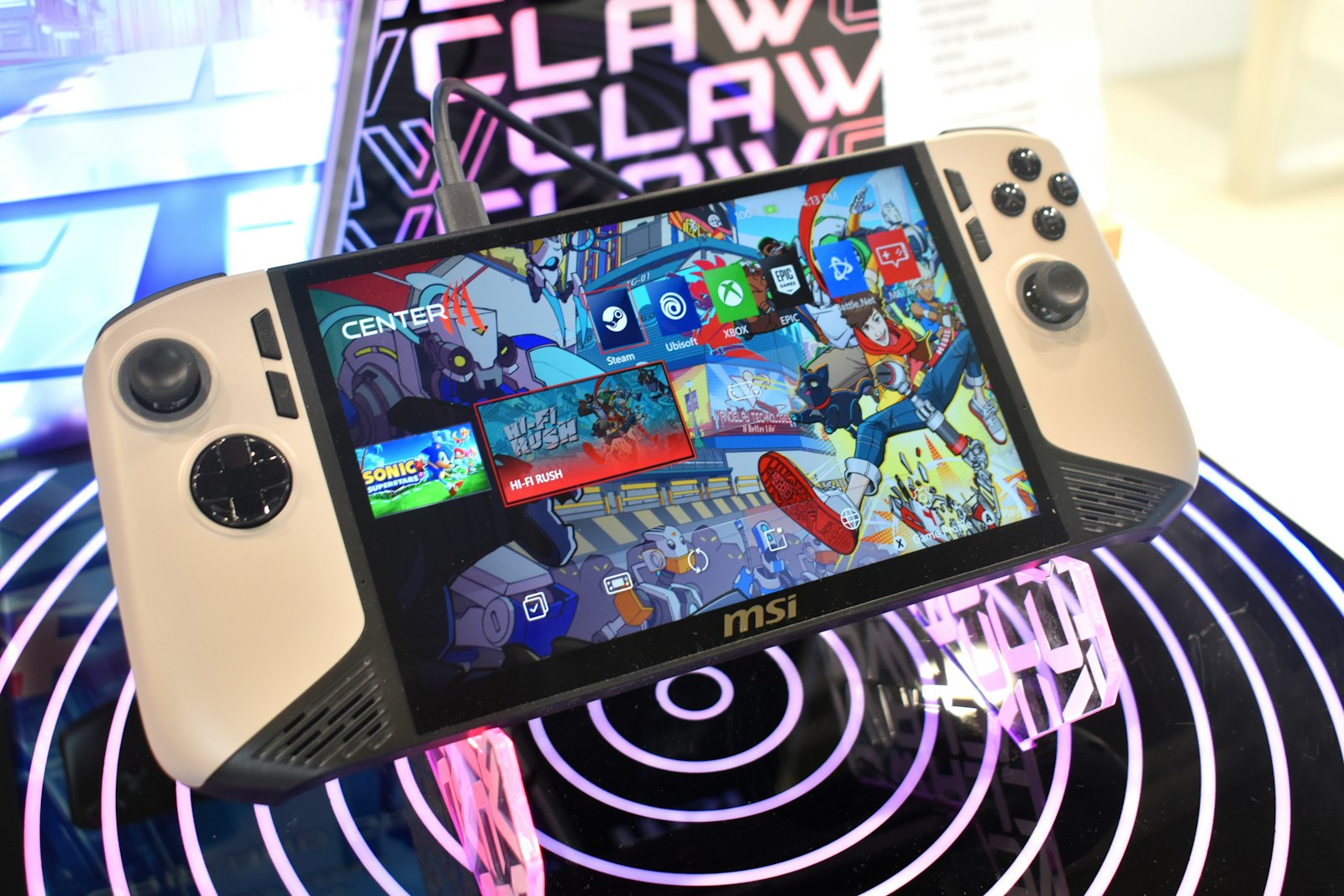
The most interesting gaming news this week was not another trailer, another release date, or another loud montage. It was the continued push to make Windows handhelds feel less like tiny PCs that tolerate games and more like game machines that happen to run Windows.
That sounds like a small distinction until you have actually used one. Anyone who has tried to treat a handheld PC like a console knows the ritual: update prompt, launcher prompt, shader compilation, sign-in screen, controller focus gets lost, battery warning, wrong window in front. Then, somewhere under all that, the game you wanted to play. The Steam Deck made a lot of people less patient with that mess. Now Microsoft, ASUS, Lenovo, MSI, and the rest of the handheld crowd are circling the same obvious truth: the hardware is not the hard part anymore. The hard part is making your games feel like they belong to you when they are scattered across stores, subscriptions, launchers, and devices.
That is why the recent ROG Xbox Ally chatter lands differently than another spec sheet. The ASUS announcement framed the ROG Xbox Ally and ROG Xbox Ally X as handhelds built around a full-screen Xbox experience with PC freedom. A recent wave of coverage around Windows handhelds, including Linus Tech Tips talking about Windows gaming changing and TechRadar rounding up the latest Computex handhelds, points at the same thing from different angles. The market is tired of asking players to do operating system chores before they can get to the game.
The living room is not a place anymore
For a long time, platform identity was simple. Nintendo lived under the TV or in your backpack. PlayStation lived under the TV. Xbox lived under the TV. PC lived at a desk. You could cheat those categories a little, but the shape of the hardware told you what the platform thought you were doing.
That map is gone now. Or at least it is full of holes.
A game might start on Game Pass through a Windows handheld, continue on a desktop through Steam, move to a console because the couch is free, then sit untouched for three months until you remember it exists during a sale. Your save data may follow. Your achievements may follow. Your receipt may follow. Your memory of why you cared usually does not.
This is the part of the handheld boom I keep coming back to. The industry talks about access, which is fair. More ways to play is good. But access is only half the story. Once every game can be played almost anywhere, the old platform shelves stop doing the quiet organizational work they used to do. The box on the shelf, the cartridge case, the console home screen, even the Steam library grid, all of those were crude memory systems. They reminded you where you had been.
The new world is better in plenty of ways. It is also weirdly forgetful.
Handheld PCs expose the mess we learned to ignore
The reason handheld PCs are such a useful pressure test is that they remove the patience buffer. At a desk, we tolerate nonsense. We alt-tab. We tweak settings. We search an error message. We accept that PC gaming sometimes asks for a little unpaid technical support.
In your hands, on a couch, none of that feels charming. A launcher that steals focus is not a minor annoyance. It is the difference between playing for twenty minutes and putting the device back down. A game that demands a keyboard for one login box feels absurd when the whole promise was portability. A library spread across Steam, Xbox, Epic, GOG, Battle.net, itch.io, and whatever else you installed last year stops feeling abundant and starts feeling like laundry.
This is why full-screen handheld interfaces matter. They are not just skins. They are an attempt to hide the parts of PC gaming that never made sense outside a desk setup.
But hiding the mess is not the same as solving it. If the next wave of devices gives us smoother launchers but the same fragmented memory, players will still be left doing their own archaeology. Which version did I play? Did I finish this on Xbox or Steam? Was that roguelike a thing I loved, or a thing I merely respected? Why is this game in my library, and what was I hoping it would be?
Those questions sound small. They are not. They are the texture of being a player over time.
A library is not the same as a history
Game platforms are very good at proving ownership. They are less good at preserving context.
Steam can tell you how many hours you spent in a game. Xbox can show achievements. PlayStation has trophies. Nintendo has its own record of play activity. Those signals matter, but they are thin. They tell you that something happened. They rarely tell you what it felt like.
This is where I think the handheld moment gets emotionally interesting. The more games become portable across devices, the more your actual history separates from any one machine. The old question was, "Where do I own this?" The newer question is, "Where does this sit in my life?"
Maybe you played a huge RPG during a rough winter and never want to touch it again, even though you loved it. Maybe you bounced off a tactics game because the tutorial was dense, not because the game was bad. Maybe you want to remember that a friend recommended something during Summer Game Fest week, before the next sale buries it. Maybe you tried five Steam Next Fest demos and only one left a mark, but two months later the names have blurred together.
A platform account will not save most of that for you. It was not built for that. It was built to sell, launch, patch, and verify. Useful work. Necessary work. Just not the whole job.
That gap is one of the reasons Perthro exists. Perthro is an iPhone-first social gaming journal, free on the App Store, built around tracking what you are playing, have played, plan to play, or shelved. You can rate games, write reviews of any length, keep a backlog and wishlist, make custom lists, and import libraries from Steam, PlayStation Network, and Xbox Live where the platforms allow it. The point is not to replace the stores. The point is to keep a calmer record beside them.
The best device will still be the one that gets out of the way
There is an arms race quality to handheld coverage right now. More screen. More battery. More performance. Better grips. Better thermals. Higher price. Lower price. SteamOS versus Windows. Xbox-flavoured Windows versus normal Windows. It is all interesting, and some of it genuinely matters.
Still, I suspect the winning feeling will be quieter than the marketing suggests.
The best handheld is the one that lets you press a button and resume the thing you meant to play. The best library is the one that does not punish you for having bought games in the wrong decade, on the wrong storefront, during the wrong hardware cycle. The best interface is the one that understands the difference between a collection and a queue.
This is where the console makers still have an advantage. A console does not have to explain itself. It has one store, one controller language, one update path, one idea of what the home screen is for. PC handhelds have more freedom, but freedom comes with clutter. Microsoft and ASUS seem to understand that the Xbox layer has to do more than sit on top of Windows. It has to make Windows feel less present.
That is a funny goal for a platform owner, but it is probably the right one.
We need better memory, not just better access
The danger in all this is that the industry treats play as a logistics problem. If a game can be streamed, downloaded, resumed, wishlisted, discounted, launched, and synced, then the system is working. From a technical angle, maybe it is.
From a human angle, I am less sure.
Players need access to games, sure. They also need ways to make sense of them. They need places to put the half-finished things without turning them into shame. They need a record of the games that mattered for reasons a storefront cannot infer. They need friends nearby, not as an engagement machine, but as people whose taste and memory help anchor their own.
That sounds soft until you look at how people actually talk about games. They do not say, "I consumed 47.3 hours of interactive content on compatible hardware." They say, "I played that the summer I moved." Or, "I never finished it, but I still think about the music." Or, "I should give that another shot now that I am less tired." The history is personal first and technical second.
The handheld PC wave is exciting because it makes more of our games reachable. It is also a little exposing. It shows how much of our play lives in gaps between platforms. If Windows handhelds get cleaner over the next year, good. I want that. I want fewer launchers in the way. I want portable PCs that feel less like work.
But the device is only the doorway. The better question is what we carry through it, and whether we remember why we opened it in the first place.