You've just finished a game you loved. The credits have rolled, maybe there was a final scene after them, and now you're sitting with the controller in your hand while the main menu plays its music.
The next evening you sit down to play something else and it feels wrong. Nothing grabs you. You open four games and close them all. If that sounds familiar, you're not alone, and it isn't just a feeling people joke about online. In 2026, researchers published the first scientific scale for measuring it. They call it post-game depression. Here's what it is, why it happens and what actually helps.
What post-game depression is
Psychologists Kamil Janowicz of SWPS University and Piotr Klimczyk studied 373 players across two studies and published a scale for measuring the experience in the journal Current Psychology. "Post-game depression is real and could be measured in a reliable way with our questionnaire," Janowicz said.
They found it has four parts:
| Component | What it feels like | How strong it was |
|---|---|---|
| Game-related ruminations | You keep thinking about the game, its story and characters | Strongest |
| Challenging end | Sadness or emptiness that it's over | Strong |
| Necessity of repeating | An urge to replay it or go back | Moderate |
| Media anhedonia | Other games, shows and books feel flat | Weakest |
Players of role-playing games were the most affected, and the more time people spent with RPGs, the stronger their symptoms. The researchers describe it as "a specific type of grief after loss" and stress that it isn't a clinical depressive episode. It's a normal reaction to losing something you cared about.
Why it happens
A long game becomes part of your life. For weeks, you knew what your evenings looked like and where you'd pick up. You spent time with its characters, learned its world and had small goals to chase. When it ends, all of that goes at once.
Research on TV shows offers a useful comparison. When the Australian soap Neighbours ended in 2022, psychologist Adam Gerace of CQUniversity surveyed 1,289 fans. They reported sadness, anger and disbelief, and many said they had no sense of closure. The strongest grief came from fans with the deepest emotional bonds to characters. "Viewers who invest in a series do care about the fortunes of their favourite characters," Gerace wrote. Fans also reported deep gratitude for what the show had given them, which is worth remembering.
There's also a comparison problem. Whatever you play next is measured against something you just loved at its very best moment: the ending. Almost anything looks flat next to that.
Finishing a game is rarer than you think
If a game's ending hit you hard, you've done something most players don't. Steam's global achievement stats show how many owners of a game reach its ending. The numbers below are for everyone who owns each game on Steam, as of early October 2026.
| Game | Reached the opening milestone | Reached an ending |
|---|---|---|
| Baldur's Gate 3 | 89% escaped the nautiloid | 24% completed the game |
| Clair Obscur: Expedition 33 | 88% set off on the expedition | 40% reached the end |
| Hollow Knight: Silksong | 85% beat the Bell Beast | 41% reached the first ending |
| Red Dead Redemption 2 | 73% finished Chapter 1 | 24% finished Arthur's story |
| Elden Ring | 71% beat Margit | Under 3 in 10 saw the most common ending |
Nearly nine in ten Baldur's Gate 3 owners start it. Fewer than a quarter see the credits. So when you finish something, it's worth treating as an event, not just the moment you move on.
Give the game a proper ending
The first thing to do is nothing. You don't need to start another game the next day. Let the one you finished sit for a while. Research on holidays suggests the afterglow of something good fades fairly quickly: one Dutch study found that even after a very relaxing trip, people's extra happiness lasted only about two weeks. Enjoy it while it's there.
Then a few things help close it out properly:
- Write down what you thought. A few sentences about how you felt, your favourite moment and what you'll remember. It doesn't need to be a review. In a year you'll be glad you did. Our guide to keeping a game journal has easy prompts.
- Look at your screenshots. Most of us take dozens and never look at them again. Going through them after the ending is like flicking through holiday photos.
- Read or watch what other people thought. Reviews, essays and ending explainers are much more interesting once you've finished. You'll notice things you missed and find people who loved the same moments.
- Talk to someone who's played it. If a friend recommended it, tell them you finished. Shared endings fade more gently than ones you carry alone.
The game you can't play twice
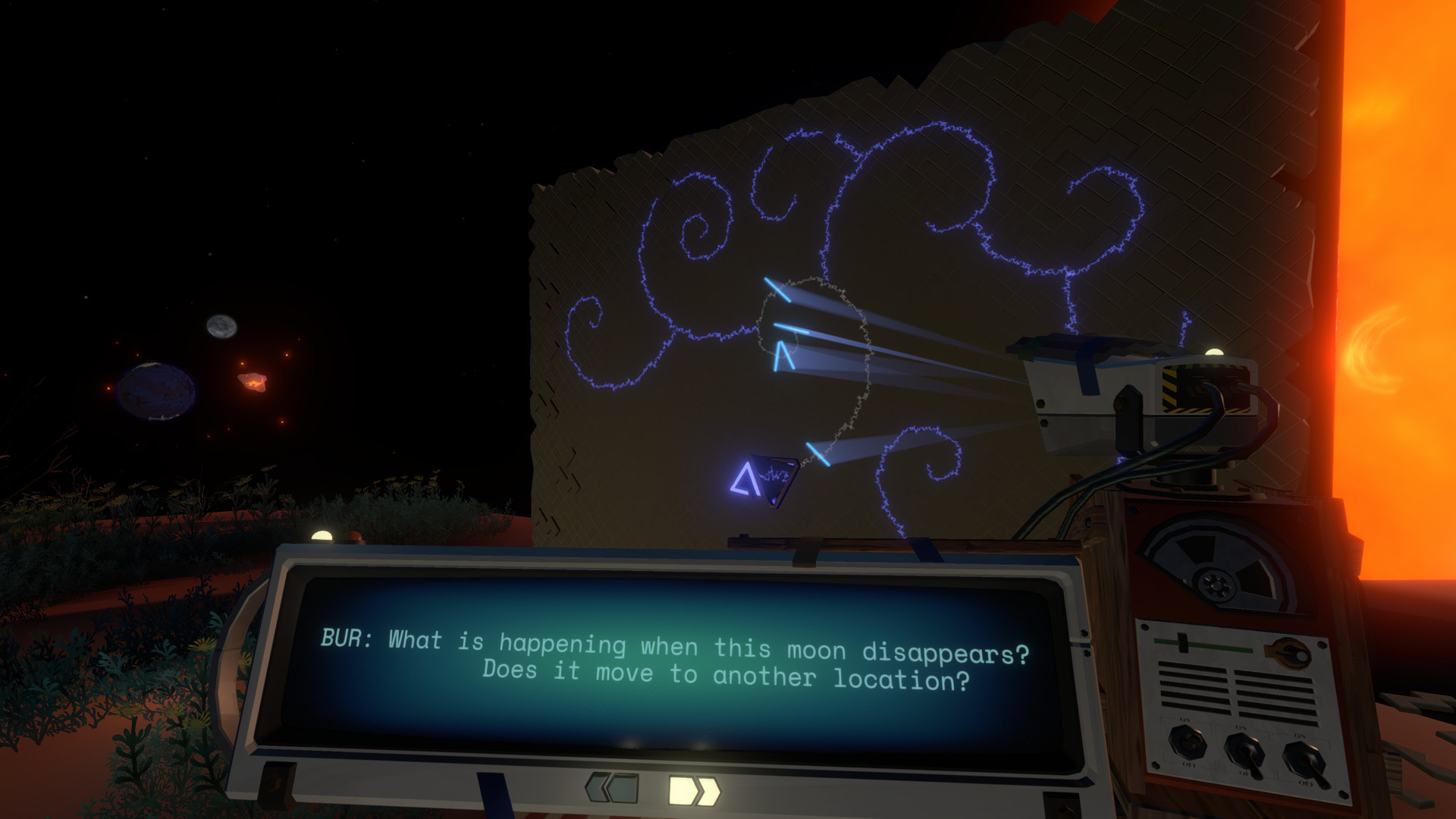
Some games hit hardest because you can only experience them once. Outer Wilds is the classic example. Its whole design is about discovering how a tiny solar system works. As its creator Alex Beachum put it early in development, "the sole purpose of exploration is to answer questions about the world you're in." Once you know the answers, you can't un-know them, and players often say they wish they could forget the game and play it for the first time again.
That feeling deserves respect. Not every great game needs a replay, and the "necessity of repeating" the researchers describe doesn't have to be obeyed. Sometimes the memory is the point. We wrote about when replaying is worth it in why we replay the games we love.
How to choose your next game
When you're ready to move on, a few rules make the next one easier to start:
- Pick something different. If you just finished a 60-hour fantasy RPG, don't start another one. Try a short puzzle game, a racing game or something with friends. Comparison is harder when the games have nothing in common.
- Pick something short. A game you can finish in a weekend gets you back into the habit without a big commitment. Here's a list of those.
- Go back to a comfort game. Sometimes the right move is something familiar that asks nothing of you.
- Don't force it. If nothing sticks, read our guide on when to stop playing a game you're not enjoying. It's fine to try a few things before one takes.
The good news
Post-game blues are a sign the game did its job. It mattered enough to leave a gap. The next one will come along, maybe not tomorrow, and when it does, you get to feel all of this again.
In Perthro, finishing a game is a moment you can log with a rating and a few words, so the games that left a gap are easy to find again later.
Sources
- PsyPost: Researchers say post-game depression is a real phenomenon
- Science in Poland: New study reveals emotional toll of finishing video games
- The Conversation: Neighbours vs Friends, which show fans mourned more
- NBC News: Feeling grief when your favorite TV show ends
- HealthDay: Happy from your vacation? It won't last
- Steam global achievements: Baldur's Gate 3
- Steam global achievements: Clair Obscur: Expedition 33
- Steam global achievements: Hollow Knight: Silksong
- Steam global achievements: Red Dead Redemption 2
- Steam global achievements: Elden Ring
- Game Developer: Road to the IGF, Alex Beachum's Outer Wilds